GREEN
The mid-hump overdrive, in circuit
OR Green Drive
What it does
OR Green Drive is a circuit model of the classic mid-hump op-amp overdrive. It does not use a curve: it solves the schematic, sample by sample, at four times the rate. The diodes in the op-amp's feedback, the 720 Hz gain leg, the tone network and the buffers are all there.
Drive sets the gain from 21 to 41 dB in the mids, with less treble as it rises. Tone goes from a treble cut to a treble boost. Three voicings come from the circuit's history: Classic, Fat and Asymmetric.
In OpenRig
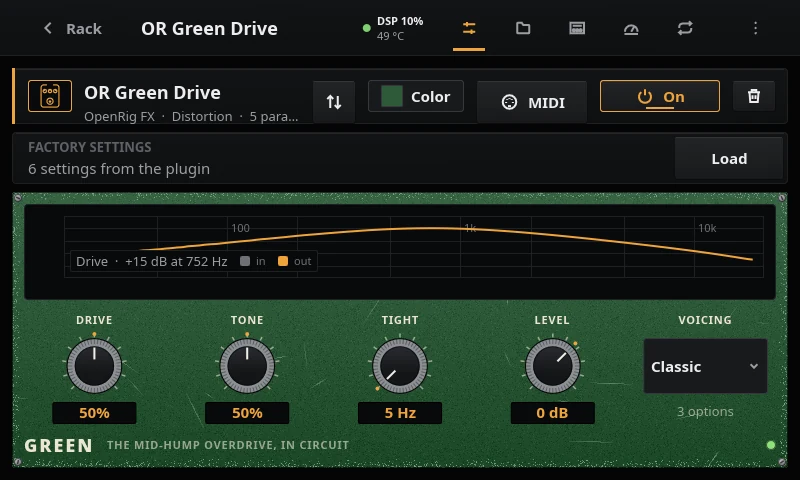
A faceplate of its own: a worn green plate, skirted knobs with a value window, the voicing switch, and a window that shows the response.
When to use it
- In front of a high-gain amp, as a tight boost: drive low, level up.
- A mid-focused crunch on its own.
- A singing lead with the mid hump.
Voicing notes
In heavy music, this overdrive is mostly a boost in front of a high-gain amp: drive near zero, level up, and the low end kept out of the amp's clipping.
The circuit already lifts the mids and leaves the lows alone. Tight, the OpenRig touch, takes the lows out too: a 12 dB per octave high pass before the clipping, swept from 5 Hz (out of the way, even for a low E tuned an octave down) to 700 Hz.
The sweet spot is the Tight Boost preset: Drive 0, Tone 55, Level +9 dB, Tight 250 Hz. There, a low E comes out about 20 dB lower, while 1 kHz loses less than 1 dB.
Fat and Asymmetric stay as the historic variants. Fat reaches lower into the clipping. Asymmetric gives more output and even harmonics.
Controls
OR Green Drive · Mono| Control | Range | Default | What it does |
|---|---|---|---|
| Drive | 0 % to 100 % | 50 % | The 500 kΩ audio-taper pot in the op-amp's feedback: gain from 21 to 41 dB in the mids, less treble as it rises. |
| Tone | 0 % to 100 % | 50 % | The active tone network after the fixed 723 Hz low pass: from a treble cut to a treble boost. |
| Tight | 5 Hz to 700 Hz | 5 Hz | OpenRig: a 12 dB/octave high pass before the clipping, from 5 Hz (out of the way) to 700 Hz. Around 150 to 300 Hz in front of a high-gain amp, it keeps palm mutes tight. |
| Level | −24 dB to +12 dB | 0 dB | Output level; 0 dB is about the bypassed level at the middle of Drive. |
| Voicing | Classic, Fat, Asymmetric | Classic | Classic: the original values. Fat: a larger capacitor in the gain leg, the clipped band reaching lower. Asymmetric: two diodes in series on one side, more output and even harmonics. |
Presets
Values that differ from the defaults- Asymmetric Crunch
- Drive 70 %, Tone 55 %, Level −2 dB, Voicing Asymmetric
- Classic Green
- The defaults
- Clean Push
- Drive 0 %, Level +6 dB
- Fat Rhythm
- Drive 40 %, Tone 40 %, Voicing Fat
- Lead Hump
- Drive 80 %, Tone 60 %
- Tight Boost
- Drive 0 %, Tone 55 %, Tight 250 Hz, Level +9 dB