BLACK
Op-amp hard clipping, in circuit
OR Black Dist
What it does
OR Black Dist is a circuit model of the classic op-amp hard-clipping distortion. A high-gain op-amp stage drives a pair of diodes to ground, then a passive filter and a buffer.
The op-amp has its real limits: its gain-bandwidth, its slew rate and its supply rails. So the more gain you add, the more its bandwidth closes, as on the real circuit.
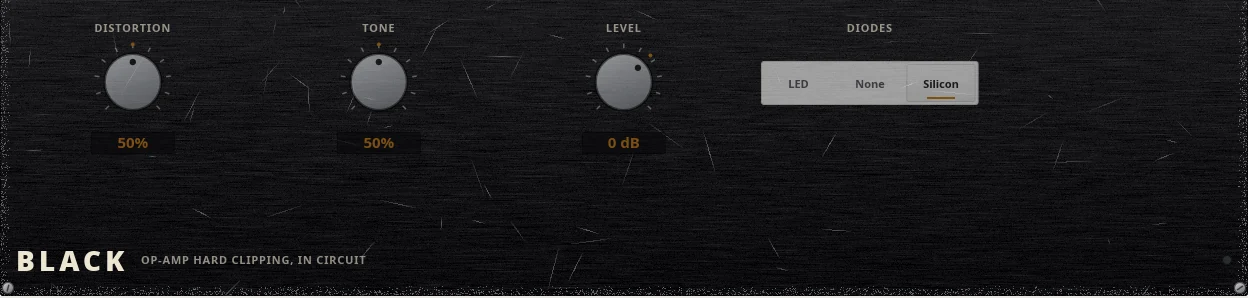
Distortion goes from unity to 67 dB of gain. Tone is the passive filter, from 475 Hz to 32 kHz. Diodes picks what clips: silicon, LEDs, or none at all.
In OpenRig
A faceplate of its own: a brushed near-black plate with domed knobs and the diode switch.
When to use it
- Silicon for fast, tight low riffs.
- LEDs when you want your picking dynamics to come through.
- No diodes for a raw, full op-amp crunch.
Voicing notes
The OpenRig touch is the diode selector. The same circuit solves each choice, and each one is level-matched at the middle of Distortion, so switching compares characters, not loudness.
Silicon is the original: it clips at about 0.6 V. It is the tightest and most compressed, for fast low riffs.
LED clips at about 1.7 V and is more open. A quiet note comes out 9.9 dB under a loud one, against 3.4 dB with silicon, so your picking dynamics survive.
None removes the diodes: the op-amp clips on its own ±3.5 V rails, and its slew rate rounds the edges. It is rawer and fuller.
The clipped signal is close to a square wave, so the circuit runs at eight times the rate. On a 2 kHz tone at full distortion, the folded noise falls to −58 to −64 dB with silicon, −64 to −71 dB with LEDs and −73 to −80 dB without diodes.
Controls
OR Black Dist · Mono| Control | Range | Default | What it does |
|---|---|---|---|
| Distortion | 0 % to 100 % | 50 % | The 100 kΩ audio-taper pot in the op-amp's feedback: from unity to 67 dB of gain, the op-amp's bandwidth closing as it rises. |
| Tone | 0 % to 100 % | 50 % | The passive filter after the diodes, from 475 Hz to 32 kHz: up is brighter. |
| Level | −24 dB to +12 dB | 0 dB | Output level; 0 dB is about the bypassed level at the middle of Distortion. |
| Diodes | Silicon, LED, None | Silicon | The clipping diodes to ground, level-matched at the middle of Distortion. Silicon: the original, tight. LED: clipping later, more open. None: the op-amp clips on its own rails, slew-limited, rawer. |
Presets
Values that differ from the defaults- Classic Black
- Distortion 60 %
- Grit
- Distortion 30 %, Tone 60 %
- Open LED
- Distortion 70 %, Tone 55 %, Diodes LED
- Raw Rails
- Distortion 80 %, Tone 35 %, Diodes None
- Wall
- Distortion 90 %, Tone 40 %, Level −2 dB